
What is space made of?
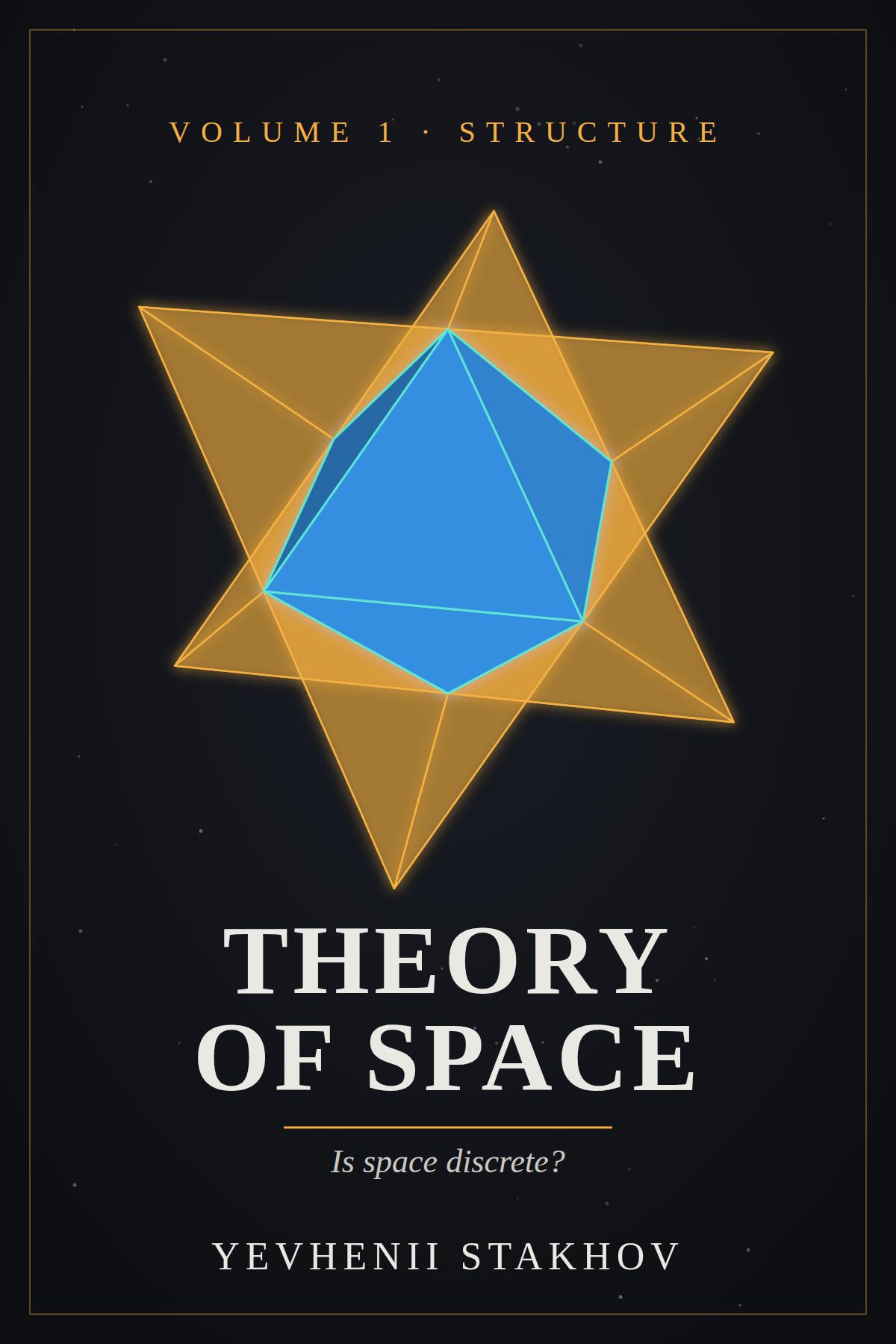
A tetrahedron and an octahedron fill space with no gaps. What if that is not a coincidence?
What's here
◇ Tools
Interactive instruments you can use right in the browser: a 3D lattice model, a nuclide table, and more on the way.
◇ The problems
Open questions from Volume 1, in working form, numbered exactly as in the book.
◇ The dialogue
Open letters to physicists. Replies are published in full and unedited.
Volume 1. Structure
Is space discrete? The geometry of space as the first cause of physics.
From the diary
The depth ambiguity gallery
A new tool: rotating wireframe solids with no depth cues, in which the same picture spins both ways. Why the lattice's building blocks make a good test of perception.
Six preprints updated
New versions of Lorentz Shield, Supergeometry, Clans, Two Lengths, Two Rulers and Mass–Radius — with weaker claims where the evidence is weaker, and priority corrected to 2013.
The law of consolidation: eight ways to grow a lattice
A lattice that contains itself at every scale can be read upwards as growth. A new preprint proves that each step has exactly eight possible choices — so a cell's genealogy cannot be read from the lattice alone.
Join in
Questions and critique
Questions, objections, ideas — every message is read by the author. Substantive critique may be published (with your consent) in the diary.
Co-authorship
Have a solution to an open problem? The strongest contributions will be credited in the next volumes.